Generative Engine Optimization (GEO) determines whether ChatGPT, Perplexity and Google AI Overviews cite your brand or your competitor’s. SEO got you into the search results. GEO gets you into the answer. Studio Ubique is a GEO agency that structures content, technical markup and entity signals so AI systems use you as a source.

Generative Engine Optimization means optimizing content and brand signals so AI systems cite you in their answers. SEO fights for a click. GEO fights to be the answer itself. The Princeton/Georgia Tech study (KDD 2024) confirms it: adding statistics and citing sources works. Keyword stuffing works against you.

Google AI Overviews, ChatGPT and Perplexity build answers from sources they trust. If your content is clearly structured, factually grounded and marked up with the right schema, you become that source. Most websites aren’t set up for that. They’re built to rank, not to be quoted. Two different things.

AI systems don’t think in keywords. They think in entities: people, organizations, concepts and the relationships between them. If your business isn’t recognizable as an entity, with consistent information on your site, in schema markup, on Wikipedia, in directories and on LinkedIn, you don’t exist to those systems. We map your entity profile and fill the gaps.

Most content was written for Google circa 2019: keyword in the title, 1,500 words, hope for a snippet. AI systems work differently. They cite the first 40 to 60 words of a section when those words give a direct, factual answer. We restructure existing content to make it citable, without rewriting everything from scratch.

The Princeton GEO study found that content with a statistic every 150 to 200 words was cited up to 40% more often. Content with superlatives and sales language got skipped. We rewrite sections to be more factual, name sources and include concrete numbers. Less “we’re the best,” more “here’s what the data shows.”

ChatGPT and Perplexity don’t just cite your site. They pick up signals from news outlets, Q&A platforms, directories, Reddit, niche blogs and industry bodies. If your brand doesn’t appear there consistently, the evidence AI systems need to recommend you is missing. We map where you need to be and help you get there.

Schema markup that’s half-implemented is sometimes worse than no schema at all. Wrong types, missing fields, plugin conflicts. AI systems read that data to understand what you are, what you do and how you compare to your competitors. We audit your current schema, fix what’s broken and add what’s missing: Organization, LocalBusiness, FAQPage, HowTo and SameAs links to all your external profiles.

Most analytics setups don’t recognize traffic from AI tools. It disappears into “direct” or “(not set).” That means you’re making decisions on incomplete data. We set up tracking so you can see how much traffic comes from ChatGPT, Perplexity and AI Overviews, and we monitor whether your brand gets cited. Generative Engine Optimization without measurement is guesswork.


languages from day one
Webshop for custom printed socks, without a checkout

4x catalogue growth in 2 years
Shopify rebuild for performance parts
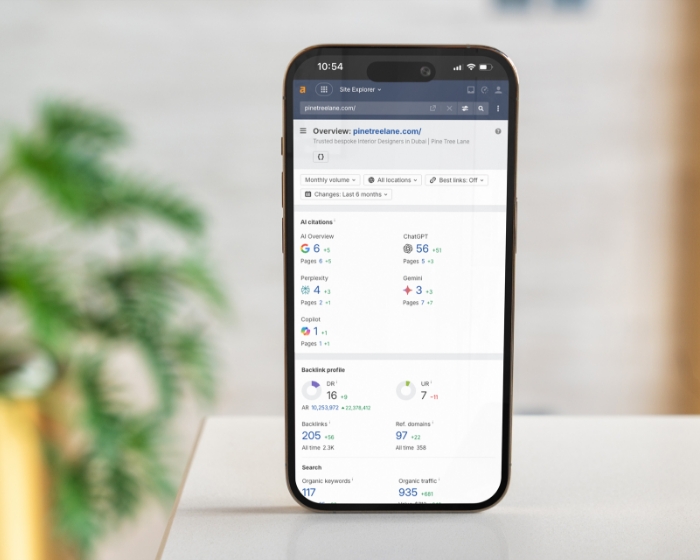
traffic growth in 6 months
Digital growth for a luxury interiors brand

less time spent on web updates each year
WordPress multisite for camping reservation software

filter usage rate (usability test)
Ecommerce landing and category redesign: desktop case study

lead growth in 6 months
Digital growth for a web agency
Most companies that come to us already do SEO. Sometimes for years. They notice something is shifting but can't pinpoint what. These are the six patterns we see most.
01
You Google your own market, ask ChatGPT the same question and see a competitor you’ve always outranked. Feels unfair. It isn’t. They have content that’s citable: factual, structured and backed by entity signals you’re missing.
02
You’re still on page one. But Google now answers the query above your snippet, in an AI Overview. The click that used to be there is gone. You’re not losing positions, you’re losing clicks. That’s the whole point of GEO: being in the answer itself, not below it.
03
Publishing more content doesn’t help if it’s not written to be cited. AI systems look for direct answers in the first sentences of a section, not a 200-word preamble before you get to the point. Structure determines whether you get cited, not length.
04
Ask ChatGPT: “Which agency in [your market] does X?” If your name isn’t there, that tells you enough. Most companies have never checked how AI systems present them. Sometimes it’s accurate. Often it’s not. And when it’s not, potential clients take that wrong information at face value.
05
Schema markup that’s half-implemented, with wrong types or missing fields, can look fine in a basic audit. But AI systems read that data more literally than Google ever did. A wrong Organization type or a missing SameAs link can be the difference between getting cited and getting ignored.
06
Honestly: most agencies aren’t doing Generative Engine Optimization yet. That’s not a criticism, the field is less than two years old. But it is a reason to ask whether your strategy accounts for how AI systems select sources. If the answer is no, you have half a strategy.
GEO is a young field. The only peer-reviewed research is from 2024. The rest is correlation. We’re upfront about that. What is established: fact density and clean schema score better. Studio Ubique applies those principles, measures what works and adjusts. No secret formula, just a method.
The questions that come up most often, answered here. Yours not among them? Just ask, there's a human on the other end.
Generative Engine Optimization is the practice of structuring your content, brand signals and technical setup so AI systems (ChatGPT, Perplexity, Google AI Overviews, Claude, others) cite your brand when users ask questions in those tools. Where SEO optimises for being found in search results, GEO optimises for being the source AI systems quote when they generate an answer.
The work has three pillars: technical setup (schema markup, structured content, machine-readable signals like llms.txt), content restructuring (direct answers in the first sentences of a section, fact density, source citations), and entity signals (consistent brand information across your site, Wikipedia, LinkedIn, directories, news mentions, so AI systems recognise you as a coherent entity). All three reinforce each other. Doing one without the others is half the work.
SEO optimises for being found in search results (Google, Bing). GEO optimises for being cited inside AI-generated answers (ChatGPT, Perplexity, Google AI Overviews). The mechanics overlap: clean schema, fast pages and structured content help both. The intent differs: SEO wants the click, GEO wants the citation, even when the citation doesn’t lead to a click.
You need both. SEO still drives traffic from traditional search. GEO drives brand presence in the AI answers that increasingly sit above traditional search results, or replace them entirely for certain queries. The split between SEO and GEO budget shifts as AI search adoption grows, but right now most companies should be doing both, with GEO as a structural addition rather than a replacement. Our SEO services include the GEO work where it makes sense.
It depends on what you sell and where your buyers research. For local service businesses (consultants, contractors, agencies, professional services), GEO can be powerful because AI systems often recommend local options to “find me a [service] in [location]” queries. For B2B businesses with long sales cycles, GEO matters because buyers increasingly use AI tools during vendor research. For pure DTC eCommerce, GEO is less direct because most purchase decisions don’t go through AI tools, though brand mentions in AI answers still influence consideration.
The honest filter: structural GEO work (schema markup, content restructuring, entity consistency) is worth doing for almost any business because it also improves traditional SEO. Pure GEO-only initiatives (cross-platform brand mention building, Wikipedia entity work) only make sense if brand presence in AI answers is specifically valuable for how your buyers find you. We scope the right level of GEO work in discovery rather than pushing a one-size-fits-all package.
Technical wins (schema markup, content restructured for citation) can show up in AI answers within weeks of being live, sometimes days for high-traffic content. Entity work (cross-platform brand signals, Wikipedia presence, directory consistency) takes months to filter through to AI training data and retrieval systems. Most clients see structural changes in their AI visibility within 3 to 6 months of starting consistent GEO work.
Honest disclaimer: measuring GEO is harder than measuring SEO. AI-referred traffic often disappears into “direct” or “(not set)” in Google Analytics, so a chunk of the value isn’t directly attributable in standard dashboards. We set up tracking (UTM tags on AI-cited links, brand mention monitoring, manual checks across ChatGPT, Perplexity and AI Overviews) so you can see what’s working, but the field is two years old and the measurement tooling is still catching up.
Our hourly rate is €60-€65 across all roles (SEO and GEO specialists, content, project management). A one-time GEO audit (current state of schema, content structure, entity signals, AI visibility baseline) typically runs €1,500 to €3,500 depending on site size. Implementation work after the audit usually lands in the €2,500 to €7,500 range for the structural fixes (schema, content restructuring, llms.txt setup), with ongoing GEO work as part of a monthly retainer.
For most clients GEO sits inside our SEO Complete package, which runs €1,500 to €4,500 per month depending on scope and includes traditional SEO, technical SEO, content work and the GEO layer. Standalone GEO retainers (without traditional SEO) are also possible but less common, since the work overlaps significantly. Schedule a discovery call to walk through what would actually move the needle for your business.
Some of it, yes. Adding schema markup if you or your developer know what you’re doing. Restructuring content so the first sentence of a section directly answers the question implied by the heading. Checking that your brand information is consistent across LinkedIn, Crunchbase, your Wikipedia entry (if you have one), industry directories. Adding an llms.txt file if your site lacks one. None of this requires an agency.
Where it gets harder: entity work across knowledge graphs (which platforms do AI systems pull from for your industry, what’s missing, how to fill the gaps), cross-platform brand mention building (which Q&A platforms, niche blogs, industry bodies actually feed into AI training data), and measurement (tooling like Profound or Otterly that monitor AI mentions costs money and takes setup time to interpret). The question isn’t whether you can do GEO yourself, it’s what your time is worth and where the gaps in your current setup actually sit. The GEO audit answers that for either path.
Contact
Not everyone likes to write. Rather talk to someone first? Book a 30 to 45 minute intro call through Calendly. It's free, and by the end you'll know whether a proposal makes sense.
Book a call(opens in a new tab)Tell us what's stuck, what you want to build, or what needs fixing. We usually reply within 1-2 business days.