
Apr 03, 2026
Zero-click search: how to stay visible when nobody clicks
Your rankings are fine. Your traffic is not. Zero-click search is the gap between those two facts, and it is getting wider every year.
Ranking first on Google used to mean winning the race. Now it sometimes means being the signpost nobody stops at.
What zero-click search actually is (and why it is accelerating)
Zero-click search happens when a user types a query into Google, gets their answer directly on the Search Engine Results Page (SERP), and leaves without visiting any website.
The SERP itself has become the destination. Featured snippets (the highlighted answer boxes pulled from a webpage and shown at the top of results), knowledge panels, local packs, AI Overviews (Google’s AI-generated summaries introduced in 2024), and direct answer boxes all serve the user’s need before a click is required.
According to SparkToro’s 2024 zero-click search study, approximately 58.5% of Google searches in the EU end without a single click to any website. That is not a rounding error. That is the majority of searches.
The acceleration has two engines. First, Google has a financial incentive to keep users on its own properties. Second, AI Overviews now synthesise answers from multiple sources, which means even well-ranked pages lose the click they used to earn. The trend is structural, not a temporary algorithm quirk.
Why your traffic drops while your rankings hold
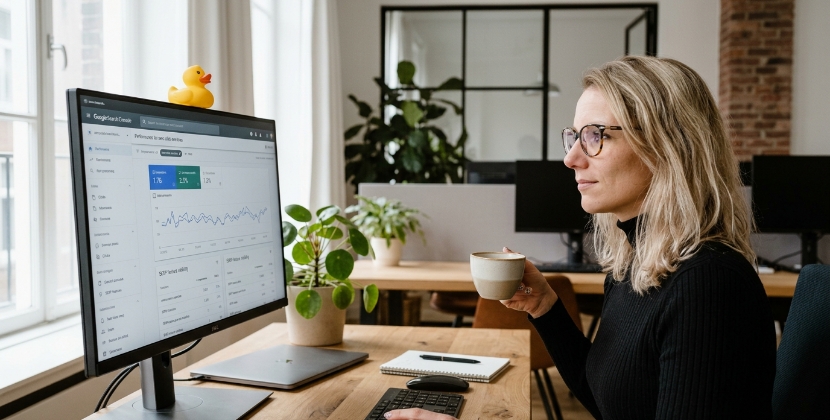
This is the moment that confuses most marketing teams. Position two in Google Search Console, impressions up, clicks flat or falling. The instinct is to blame the algorithm. The actual explanation is simpler and more annoying.
When a featured snippet answers the question above your result, the user does not need to scroll. When an AI Overview summarises three sources including yours, the user reads the summary and moves on. Your ranking is real. Your click is gone.
Research from Search Engine Land (2023) found that featured snippets can reduce click-through rates for position-one results by five to nine percentage points. That is not catastrophic on its own, but compounded across a content library and multiplied by AI Overview coverage, the cumulative effect on traffic is significant.
The businesses most exposed are those whose content answers simple, factual questions: definitions, how-to steps, prices, opening hours, quick comparisons. If your content strategy is built on informational queries, zero-click search is not a future risk. It is a current one.
Decision box
– **Best if:** your content mix includes transactional, opinion-led, or deeply specific queries that AI cannot easily summarise.
– **Not ideal if:** your entire content strategy relies on informational queries where Google can answer directly from your page.
– **Likely overkill when:** you are a local service business with strong map pack presence and most conversions happen by phone or walk-in.
The content formats that win zero-click real estate
If you cannot stop zero-click search from happening, you can at least be the source it pulls from. That changes the goal from “get the click” to “own the answer.”
Google’s featured snippets and AI Overviews have clear format preferences. Paragraph snippets favour concise, direct answers in the first two sentences of a section. List snippets favour numbered or bulleted steps where each item is short and scannable. Table snippets favour structured comparisons with clear headers.
The practical implication is that content written for human readability and content written for snippet capture are not opposites. A well-structured article that answers a question in the opening sentence, then expands with context, serves both. The mistake is burying the answer in paragraph four after three sentences of scene-setting.
There is also a format that zero-click search consistently cannot replace: opinion, experience, and specificity. An AI Overview can summarise what a featured snippet is. It cannot replicate a specific case study, a contrarian take, or a detailed walkthrough of a real client situation. That is where click-worthy content still lives.
How structured data and entity authority change the equation
Structured data is machine-readable code added to a page that tells search engines what the content means, not just what it says. Schema markup for FAQs, articles, products, and local businesses all increase the likelihood that Google surfaces your content in rich results, which are the enhanced SERP features that take up more visual space and carry more authority.
Entity SEO is the practice of optimising for how Google understands your brand, products, and topics as named concepts in its knowledge graph, not just as keyword matches. A business that Google recognises as an authoritative entity on a topic is more likely to be cited in AI Overviews and knowledge panels, even when no click follows.
This is where the zero-click dynamic shifts from threat to opportunity. If your brand is consistently cited as the source, even users who do not click are exposed to your name, your framing, and your positioning. That is not nothing. Brand recall from repeated SERP exposure has measurable downstream effects on branded search volume and direct traffic.
If you want to go deeper on how AI is reshaping search visibility, our AI SEO services page covers the practical side of that shift.
When zero-click search works in your favour
Not every zero-click outcome is a loss. The framing matters.
Consider a user who searches for a specific service category, sees your brand cited in an AI Overview, does not click, but searches your brand name directly ten minutes later. That branded search is a downstream effect of zero-click exposure. It does not show up in your organic traffic report as a zero-click win, but it is one.
Local businesses with well-maintained Google Business Profiles benefit from zero-click search in a direct way. A user searching for a service near them sees your name, rating, address, and phone number without clicking. If they call, that conversion happened entirely within the SERP. The click was never the point.
The businesses that struggle most with zero-click search are those measuring success exclusively through sessions and pageviews. The businesses that adapt are the ones that add branded search volume, direct traffic trends, and SERP feature presence to their measurement framework. What you measure shapes what you optimise for.

Building a zero-click search strategy that does not ignore clicks
The goal is not to abandon click optimisation. It is to stop treating clicks as the only signal worth tracking.
A zero-click search strategy has three practical layers. The first is format optimisation: structure your content so that if Google pulls an answer from your page, it is your framing, your terminology, and your brand name that appear. The second is entity building: make sure Google’s knowledge graph associates your brand with the topics you want to own. The third is measurement recalibration: add SERP feature tracking, branded search volume, and direct traffic to your reporting alongside organic sessions.
The content that still earns clicks in a zero-click environment tends to share a few characteristics. It is specific enough that a summary cannot replace it. It requires a decision, a download, a booking, or a purchase. It is updated frequently enough that a cached answer goes stale. It is opinionated enough that the reader wants the full argument, not the headline.
According to BrightEdge (2023), AI Overviews appeared in roughly 15% of queries during early rollout phases, with significantly higher rates for informational queries. That percentage will grow. Building a content mix that is not entirely dependent on informational traffic is not a hedge. It is a reasonable response to a documented trend.
If you are still deciding how much of your budget should shift toward AI-driven approaches, the breakdown in AI SEO vs traditional SEO is a useful starting point.
What to monitor monthly
– Impressions vs clicks ratio in Google Search Console, tracked by query type (informational, navigational, transactional)
– SERP feature presence for your top 20 target queries: are you being cited in featured snippets or AI Overviews?
– Branded search volume trend in Google Search Console and Google Trends
– Direct traffic trend in your analytics platform as a proxy for brand recall
– Click-through rate by page type, to identify which content formats are losing clicks fastest
Zero-click search now accounts for the majority of Google queries. According to SparkToro’s 2024 study, approximately 58.5% of EU searches end without a click. Businesses that adapt treat SERP visibility as a brand signal, not just a traffic source. Studio Ubique works with companies navigating this shift by combining entity SEO, structured data, and content strategy to maintain visibility even when clicks are not the outcome.
Faq
What is zero-click search and why does it matter for my business?
Zero-click search is when a user finds their answer directly on the Google results page and never visits a website. It matters because it means your rankings can be strong while your traffic stays flat, and the gap between those two things is growing as Google adds more SERP features and AI-generated summaries.
Do featured snippets hurt or help my organic traffic?
The honest answer is: it depends on the query. Featured snippets can reduce click-through rates for simple informational queries by five to nine percentage points, but they also increase brand recall and can drive branded searches later. The net effect depends on whether your business benefits more from raw traffic or from being recognised as the authoritative source.
Can i optimise my content to appear in zero-click results?
Yes. Structuring content with direct answers in the opening sentence, using clear list and table formats, adding schema markup, and building entity authority in Google’s knowledge graph all increase the likelihood that your content is pulled into featured snippets, AI Overviews, or knowledge panels.
What metrics should i track if clicks are declining?
Add branded search volume, direct traffic trends, SERP feature presence for your target queries, and impressions-to-clicks ratio by query type to your regular reporting. These give you a more complete picture of search visibility than session counts alone.
Is zero-click search a problem for every type of business?
No. Local service businesses with strong Google Business Profiles often benefit from zero-click search because users get their contact details directly in the SERP. The businesses most exposed are those whose content strategy is built primarily on informational queries that Google can now answer without a click.


Let's talk
Zero-click search is not going away, and pretending your traffic reports tell the whole story is not a strategy. If you want to figure out where your brand actually stands in the current SERP landscape and what a realistic response looks like, Studio Ubique can help you work through it without the usual amount of vague optimism.
Schedule a free 30-minute discovery call: Book a call